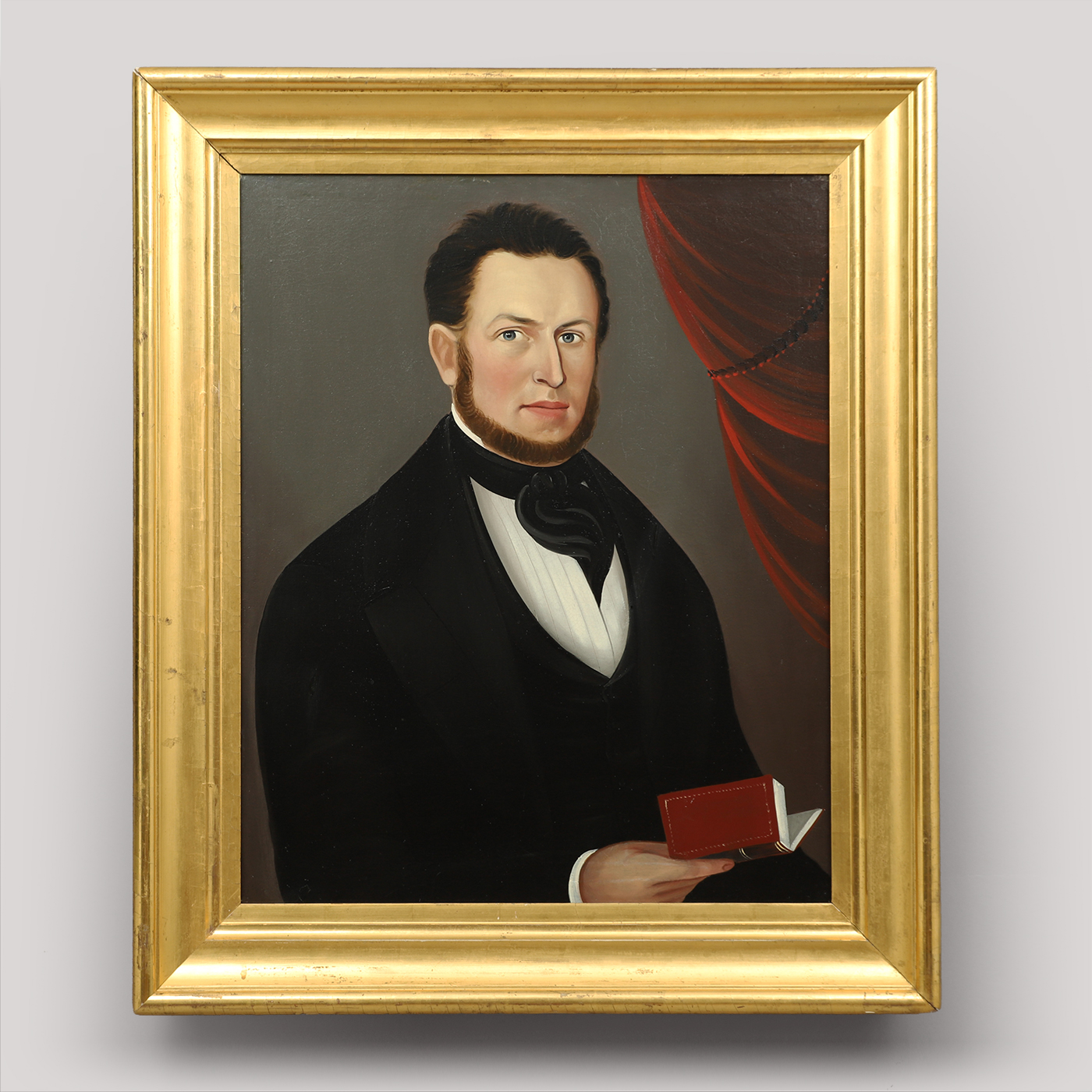
Attributed to Sturtevant J. Hamblin (active 1837-1856)
Lived/Active: Maine and Massachusetts
American School, probably New England or New York State.
Ca 1840-1850.
Portrait of a Gentleman Holding a Book.
Oil on canvas.
27″ x 22″, 34” x 29” with frame.
Fine condition, lined, with scattered in-painting in the background.
Provenance: Sotheby’s, New York, Jeffrey Tillou Antiques, 2007; Private Collection to present day.
Sturtevant Hamblin worked as a portrait painter in Portland, Maine before moving to Boston, Massachusetts around 1839. Hamblin painted with his brothers Nathaniel, Joseph, and Eli as well as his brother in-law William Matthew Prior. It is suspected that Hamlin may have studied under Prior, but it is known that he was living with his sister and Prior starting in 1837. Approximately three years later Nathaniel, Joseph, Sturtevant, Prior and his wife all moved to Boston together. Sturtevant’s brothers advertised as house, sign, and fancy painters, and it is likely that Sturtevant derived some of his income from working with them though he is the only one known to have considered himself a portrait painter. By 1856, Sturtevant left painting and entered into a “Gent’s Furnishings” business with his brother Joseph.
Sturtevant Hamblin came from a long line of artisans from the Portland, Maine area. His grandfather, George, as well as his father and brothers, Nathaniel, Joseph and Eli were all house, sign and decorative painters. The Portland, Maine directories between 1823 and 1841 even list a “Hamblin block”. The Hamblin’s sister married Matthew Prior, also a painter. When members of the Hamblin and Prior families moved to Boston they resided together at a number of different addresses in that city.
Matthew Prior and Sturtevant Hamblin shared studio space together. They referred to it as the “Painting Garret”. Sturtevant Hamblin listed himself as a portrait painter in professional directories; he was the only member of his family to do so. On occasion he probably did do some house and sign painting to augment his income.
By 1856 Sturtevant had joined his brother Joseph in the “gents furnishing business”, leaving the portrait painting profession. Art Historians believe that this may have been because of greater acceptance of portrait photography and the corresponding decline in commissions for portrait paintings.