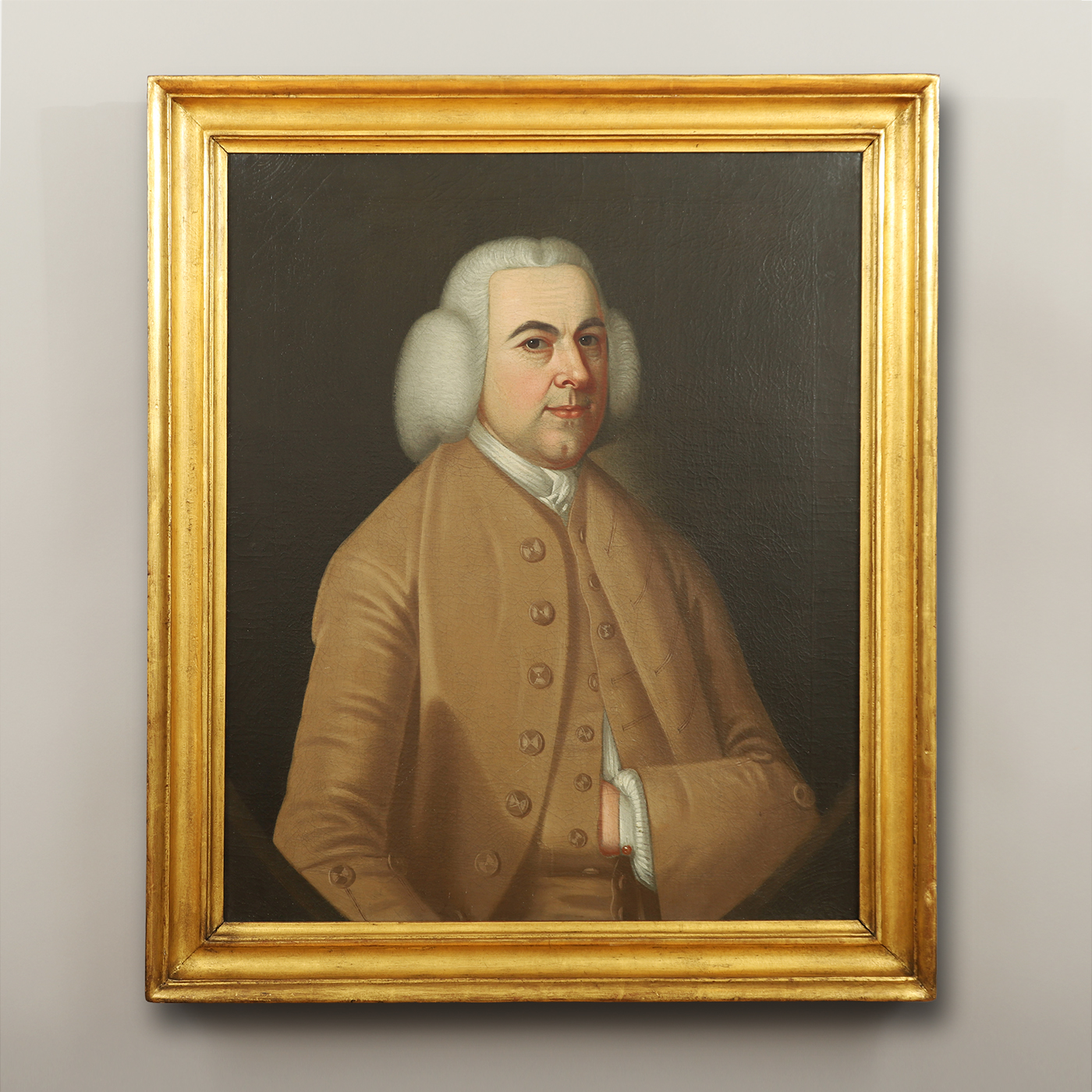
American School, Portrait of a Gentleman
Unsigned, 18th century
Oil on canvas, 30” x 25”, 34 ¾” x 29 ¾” (frame).
Over-all in fine condition with craquelure, scattered restoration around perimeter, lined on contemporary stretcher faced with portions of original stretcher.
Provenance: Frank S. Schwartz & Son, Philadelphia, PA, 1989.
This rare unsigned American Colonial-era portrait, formerly attributed to Jeremiah Theus (1716-1774), who painted mostly in South Carolina, is similar to other artists who painted in the Philadelphia area during the same time period. We are certain, based on the analysis of the original yellow pine stretcher, that this work was produced in the mid-Atlantic region or further south.
Portraiture was the most lucrative art form in colonial America and demand was primarily driven by the wealthy upper-class who coveted their painted likenesses as a status of wealth and social standing.
For further insight into our efforts to discern an attribution, including musing Charles Willson Peale (1741-1827), see below essay by Portrait & American Folk Art Specialist, Emily Esser, for whose expertise we are grateful.
The colonial gentleman whose portrait is presented here, decked out in a dapper gold waistcoat ensemble, must remain anonymous for now. However, the quest to assign a persuasive artistic attribution to him has yielded some fascinating prospects. We can be certain, through his hairstyle and general presentation, that he belongs to the latter half of the 18th century. Strongly similar portraits, nearly identically dressed in glossy satin jackets, can be found on both sides of the Atlantic. The identically bewigged portrait of Peyton Randolph, a Virginia statesman, might help to narrow down a prospective time frame and whereabouts. At first glance, the artist of Randolph’s portrait, the famed Charles Willson Peale, appears to possess a different sense of refinement and complexity than our robust, boldly painted gentleman.
But, by analyzing the course of Peale’s evolution – especially his early works, which are incredibly scarce in number – another possibility appears. Colonial Gentleman may fall within the scope of his original style, before his 1767 training alongside Benjamin West in England, which catapulted Peale to popularity after his 1770 return with a uniquely American reinterpretation of the “grand manner.” A particularly intriguing comparison is C.W. Peale’s self-portrait1, a small, humble work at the American Philosophical Society, only a few inches in scale.
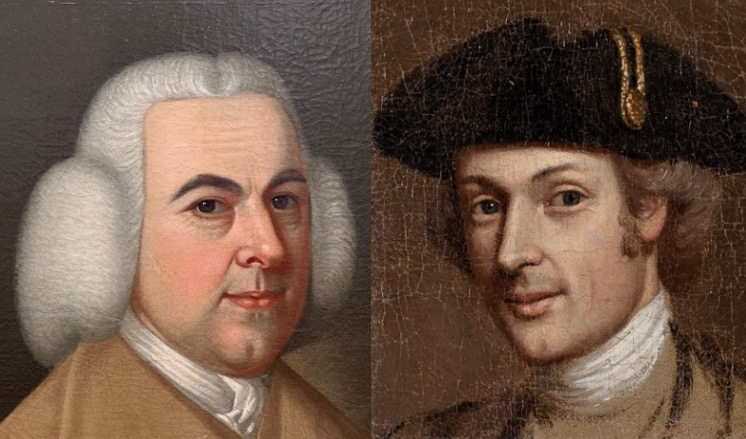
Remarkably, Colonial Gentleman and Peale’s self-portrait have an observable stylistic likeness. Compare the sharp angle of the nose; the shadows cast on the far side of the face; the rendering of the slightly pursed lips. Self-Portrait is attributed to 1777-1778, based on Peale’s captain’s hat from the Pennsylvania militia. That said, it bears little stylistic resemblance to his highly refined, signed and dated works from those years. It is tempting to suspect the painting might have an earlier date, showing the painter as a younger man; yet it is difficult to reconcile this anachronism with his military insignia, so clearly tied to historical events. It may well be a regression to his earlier style, dashed off as a visual memento of his journey through the tumultuous Revolutionary War.
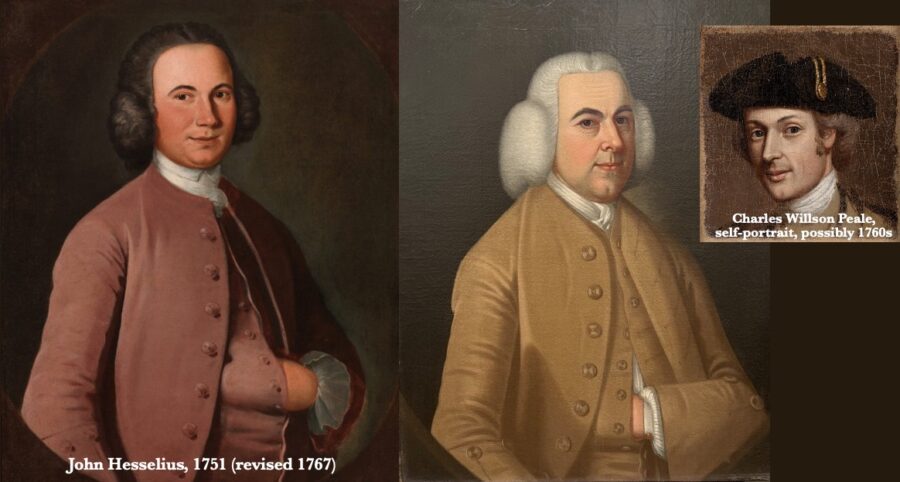
Peale’s work went through several documented evolutions. In 1763, he took a strong interest in painting, and received lessons from the notable mid-Atlantic portraitist John Hesselius. (Sadly, we have no examples of Peale’s paintings from those intervening years, rendering direct comparison impossible.) By juxtaposing Colonial Gentleman with a classic example of Hesselius’s work2, it becomes very apparent that Gentleman takes compositional cues from it. Yet, in terms of its specific style, there is very little in common, especially compared to Peale’s Self-Portrait in proximity. Gentleman cannot be by Hesselius’s hand: the face is rendered completely differently. Nor, in my estimation, does it belong to any of the other equally recognizable portrait painters of the era, who rarely varied their unique formulas in how to depict a face.
A few years later, in 1765, Peale met and studied under John Singleton Copley. Peale absorbed these lessons like osmosis. We need only look to his 1765 portrait of a New England merchant3 to see the similarity to Copley’s signature works. It is sharply lit and dramatically shaded, painted as smooth as porcelain. Peale’s work would still retain that porcelain quality, as time went on and his abilities flourished. His work is instantly recognizable. But what did Peale’s paintings originally look like, before he met any of those great names? What might we be missing?
It is currently impossible to assign a decisive attribution to Colonial Gentleman. But in the process of researching this portrait, to my eye, Charles Willson Peale’s earliest self portrait was the only truly persuasive comparison. It certainly has a great deal of promise.
– – –
Endnote: This painting’s prospective origin may support the theory. Labels on the back tell us that it was acquired by the Philadelphia gallery of Frank Schwarz & Son, later consigned through the Rental Gallery in January 1988 at the Baltimore Museum of Art. Sadly, no records from either of those sources have shed any light on the provenance.
- Self-Portrait of Charles Willson Peale, American Philosophical Society, 58.P.67. I did see this work in person – it is incredibly small! Its larger dimensions are due to its frame. https://amphilsoc.pastperfectonline.com/webobject/B43E6871-4D7D-408C-9D20-178846468937
- Henry Fitzhugh (1723-1783), Virginia Museum of History & Culture, 1954.2. https://colonialvirginiaportraits.org/portrait/henry-fitzhugh-1723-1783/
- Portrait of a New England Merchant, New Britain Museum of American Art, 1971.06. https://ink.nbmaa.org/objects/1061/new-england-merchant
Peale’s timeline is courtesy of the Smithsonian American Art Museum. https://americanart.si.edu/artist/charles-willson-peale-3720
Peyton Randolph’s portrait by Peale: https://www.theconstitutional.com/blog/2020/01/18/peyton-randolph-one-americas-founding-fathers
Discussion of Peale’s captain’s hat insignia: https://commonplace.online/article/what-the-artist-saw/?print=print