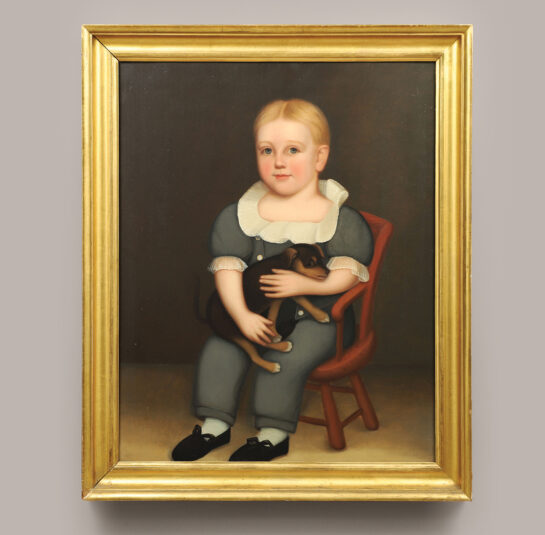
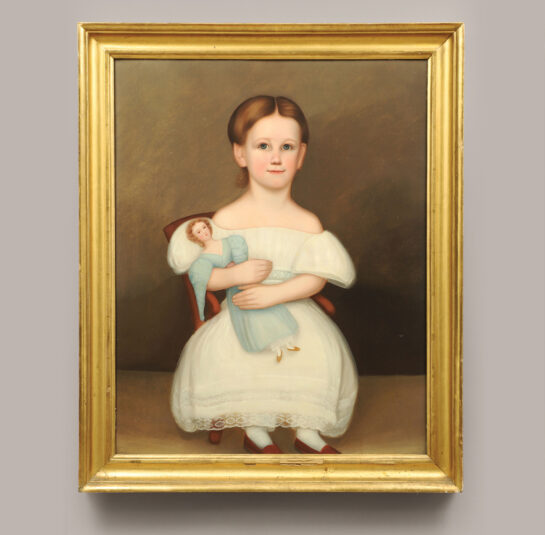
The Winter Limner Lived/Active: New England, New York, Georgia
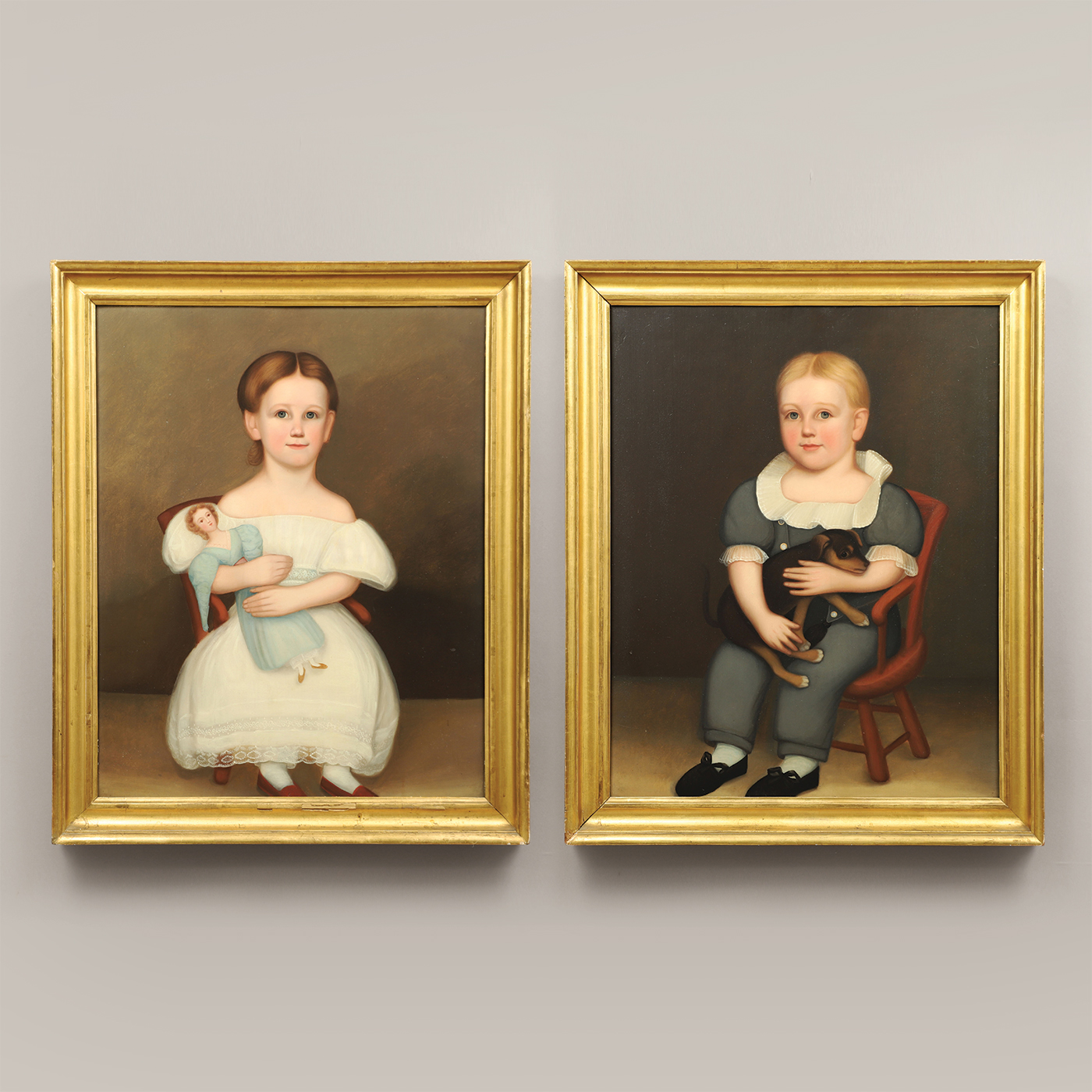
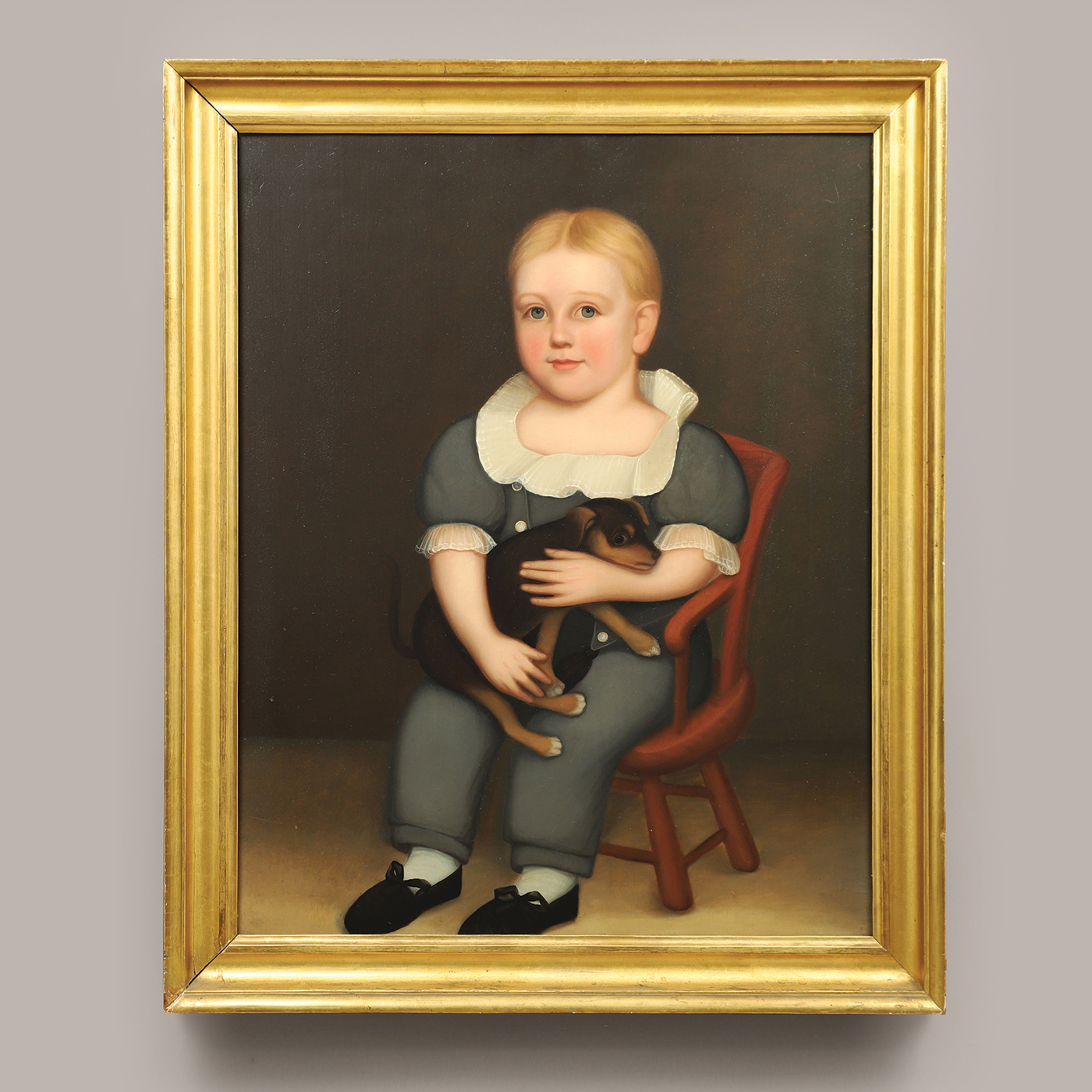
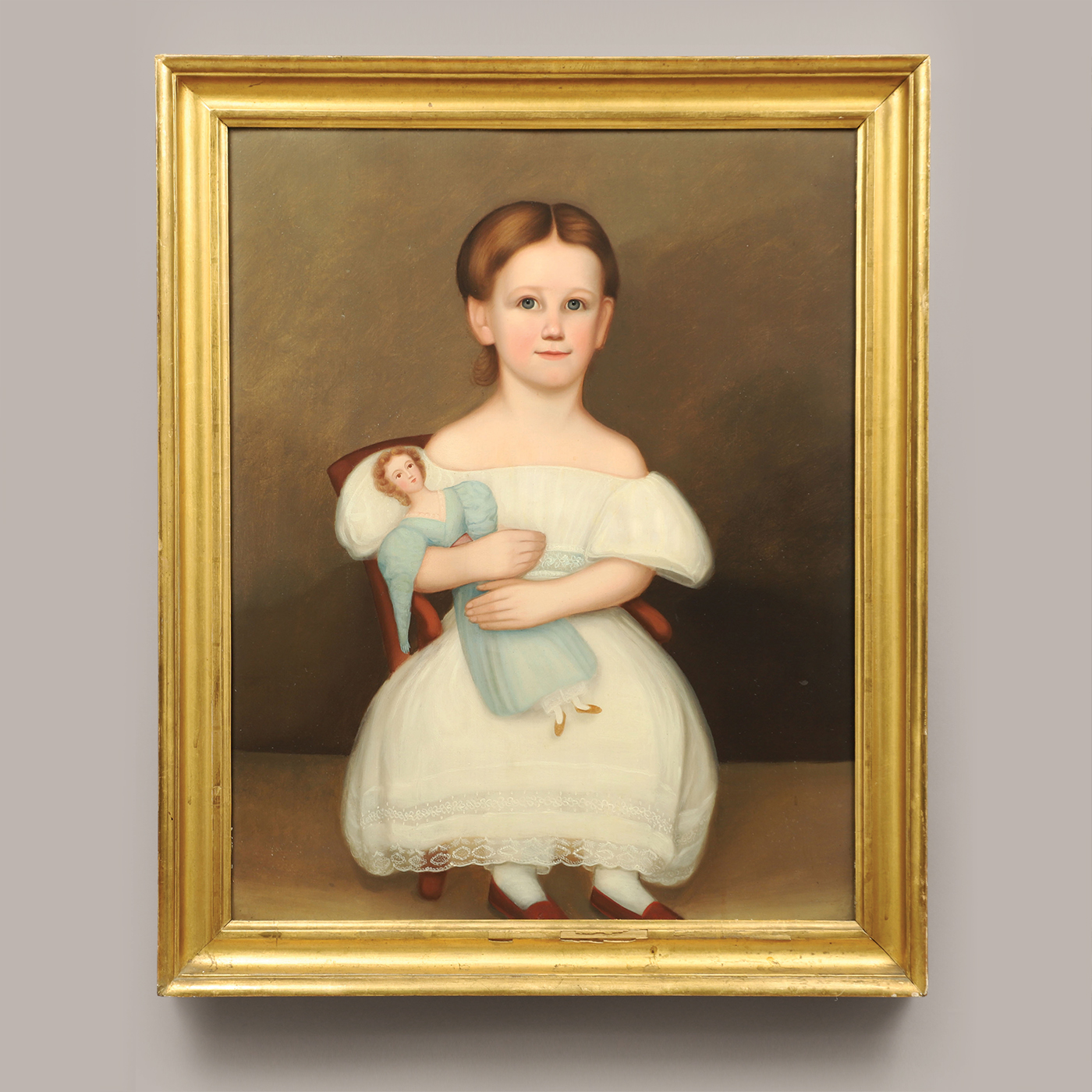
Portraits of Deborah Thompson and Elijah Thompson
Unsigned, ca. 1820-1830
Oil on tulipwood panels.
30” x 24”, 34 x 28” (frame)
Full condition report available upon request.
In period gilt wood frames.
Provenance: Collection of Mr. and Mrs. Peter Tillou, Litchfield, Connecticut, thence by descent.
Illustrated: Nineteenth-Century Folk Painting: Our Spirited National Heritage, Works of Art from the Collection of Mr. and Mrs. Peter Tillou (The William Benton Museum of Art, 1973), pl. 79 and 80.
Exhibited: The William Benton Museum of Art, The University of Connecticut, Storrs, Connecticut, 1973; The New York State Historical Association, Cooperstown, New York, 1973; Abby Aldrich Rockefeller Folk Art Collection, Williamsburg, Virginia, 1974.
These two portraits depicting Deborah Thompson and Elijah Thompson were discovered together in western New York State by Peter Tillou in 1967. According to verbal history, the Thompson family moved up the Erie Canal from Connecticut in the early 19th century.
For further information convincingly demonstrating attribution to The Winter Limner see scholarly essay by Portrait and American Folk Art Specialist, Emily Esser.*
Price: $125,000
*Portraits of Deborah Thompson and Elijah Thompson – The Winter Limner
Emily Esser, Portrait & American Folk Art Specialist
Among the American folk painters we know today, the most beloved artists are best-known for their cherished depictions of children, immortalizing fresh-faced young souls from the 1800s in bright colors and immaculate interiors. Names like Ammi Phillips, Joseph Whiting Stock, and William Matthew Prior are invariably remembered by their most spectacular and vibrant works, usually full-length child portraits, that adorn the walls of museums today. But some of the finest child portraits to be found in the world of Americana are still nameless. Often, in the absence of a signature or inscription, a scattered and disparate group of portraits may never be re-assembled by name, just individually admired and cherished. Periodically, with close scrutiny, they may be compared and confirmed, and “Anonymous” evolves into a “Limner.”
The name Peter Tillou is linked to the best of the best. The pair of child portraits known as Deborah and Elijah Thompson, discovered by Peter Tillou in 1967, are immediately recognizable – Deborah holding her matching doll in pale blue, Elijah holding a long-legged puppy. Much beloved, they have remained in the Tillou family ever since, now offered by Jeffrey Tillou Antiques. The Thompson portraits have a long and storied history, appearing in print in Tillou’s “Our Spirited National Heritage” and repeatedly featured in prominent exhibits. Yet, unlike their counterparts from the brush of Phillips or Stock or Prior, the paintings’ authorship remains an open question. Though the Thompson family history points to western New York and Connecticut, an identification has not been found for the sitters – nor for the artist. Until now.
The newfound identification of the “Winter Limner” comes in no small part due to the Thompson children. They are the best-known pair of portraits by this previously unknown painter, and the most widely published, thanks to their inclusion in the Tillou collection. This artist was originally nicknamed the “Soft Faces Painter” before receiving a “Limner” title, and has since been named after two separate double portraits* of the Winter Children from Bath, Maine (a “Thompson Limner” already exists). Known to have worked primarily in New England throughout the 1810s and 1820s, the Soft Faces Painter developed a smooth, matte, softly rendered technique that remains highly distinctive in the world of folk portraiture. Child portraits are uncommon, pairs even more so. The Thompsons are the only known pair that have not been separated by time and space, and remain in superb condition, retaining the signature sense of softness due to condition and preservation. Unusually, these two are painted on panel, a habit that the artist eventually returned to in a different phase of their career.
*”Wealthy Jones Winter and Sarah Marie Winter,” Sotheby’s, Jan. 25, 2020, Lot 1167; “Marcia and William Winter, of Bath, Maine,” Pook & Pook, Jan. 14, 2026, Lot 58.
Surprisingly, the Winter Limner has been identified once before, for entirely different reasons: the moniker “Savannah Panelist” was chosen, several decades ago, to connect a group of portraits in Georgia, a long way from home. The Winter Limner and Savannah Panelist have never before been linked. The modern-day breakthrough came due to old photographs of the Savannah group, stored in the Frick Art Reference Library archives since the 1970s. And the artist’s New England phase was not previously known by name at all, identified only as American School/Unknown Artist until an informal 2024 publication by the author. The Savannah Panelist connection was finally made in 2025. Despite this new progress, many questions still remain. The Winter Limner’s actual name and identity remains unknown, despite extensive searching in newspapers, a common means of advertisement for traveling portrait painters. Despite the medium’s popularity, not all artists used this method, preferring word-of-mouth or simply flourishing through their skills alone, as the Winter Limner must have done.
Despite the absence of a given name, connecting these pieces has permitted us to grasp the larger picture of the artist’s travels, envisioning the course of their life. What brought them to the American South after beginning their career in Maine? We do not yet know. We may never know. But, thanks to the Winter Limner-Savannah Panelist connection, we can extend the duration and the breadth of the artist’s recognized catalogue, which now includes a double portrait of a mother and daughter, Francina and Elizabeth Greer, at the Colonial Williamsburg museum. (2013.001,A). The Greer portrait had been originally omitted from the catalogue in the 2024 publication, due to its Georgia provenance, but these subsequent discoveries have permitted its inclusion, finally reconciling the remarkable stylistic likeness between little Elizabeth Greer and the Thompson children.
The Thompson portraits remain unusually special in the repertoire, both for their subject matter and their location. New York paintings are scarce, and typically belong to the middle phase of the Winter Limner’s career, before their eventual move to the South. Only a handful of named NY sitters are recognized, but the few who are currently identified may provide a clue to the chronology. At the beginning (c. 1815-1820), the artist spent significant time in Maine, with at least one detour to Vermont, but appears to have made occasional trips to New York. Cyrus Chipman, M.D*., depicted in middle age, moved to New York in 1795 and left in 1821, setting a firm end-date on the sitter’s availability. Meanwhile, a portrait of “Mrs. Biddell”† is inscribed verso, and bears a date of 1832, N.Y. Granted, its reliability is uncertain: the hand-written inscription on “Mrs. Biddell” also cites the name of John Paradise, who is now decisively confirmed not to be the Winter Limner. Nonetheless, between these two sitters, we may infer an active period from 1820 to the late 1830s in which the WL might have traveled to New York to paint the Thompson children. Intriguingly, the portrait of Mrs. Biddell is also painted on panel, featuring a darkened area on the reverse that corresponds with similar verso markings seen on the Thompson panels. However, the type of wood is different, suggesting versatility in the artist’s materials – oil on canvas was preferred. Varying mediums did not hinder the remarkably consistent art style.
*Locati LLC, Oct. 20, 2014, Lot 1014106
†DuMouchelles, Mar. 17, 2013, Lot 32106
The two Thompson portraits are also an excellent reference point for the visual cues and clues that define this artist’s work. From a distance, the Winter Limner’s oil paintings could be mistaken for pastels. The artist’s smooth surfaces, without efforts to feign gloss or shine, are a consistent, signature technique. The only exception is the eyes; there is a sense of wetness and depth in the irises, which are often quite large, especially in children. Subjects invariably have a long far-away wistful gaze, looking out into the distance, unlike so many portraits that look at the viewer. The overwhelming impression is one of softness and a gentle disposition, as if time has paused just long enough to capture the sitter in the portrait. There are occasional exceptions to these rules of thumb. The most realistic and crisp portraits by the WL (typically adult sitters) have a slight suggestion of shine to the skin. But the absence of it is substantially more common, continuing through the entire breadth of the artist’s career. Even the Savannah pictures retain these qualities, for the most part. A trio of “Savannah Panelist” portraits at the Telfair Museum in Georgia (1949.2, 1949.3, 1987.3.1) are photographed in color, expanding our understanding of the artist’s late phase (c. 1835-1840s). However, the passage of time did bring about some evolution. The Savannah sitters have a greater sense of attitude and edge — perhaps a reflection of their personalities, or of the artist’s perception of them — compared to the angelic Thompson children.
Many Winter Limner portraits are still languishing under other artists’ names. The superb “Portrait of Miss Perkins,” attributed to Joseph Whiting Stock, invites immediate comparison to both Deborah and Elijah Thompson, clearly from the same hand and paintbrush. Many other Winter Limner pieces are proudly included in museums across New England, and the entire nation — but never by name. In the absence of the artist’s historical identity, it can be very difficult to change attributions or to make the case on the behalf of the “Limner.” Therefore, it is a great pleasure to be able to add the Winter Limner’s name to the Thompson portraits at the Tillou Gallery, linking them to the artist’s entire oeuvre of work for the first time in 59 years.
*Museum of Arts & Sciences, Daytona Beach, FL; catalog number unknown.
—